The countdown to the 2026 FIFA World Cup is officially underway. Football fans around the globe are searching for the full tournament schedule, group fixtures, match dates, and the brand-new knockout stage format.
This World Cup will be unlike anything football has ever seen. For the first time in history, the tournament will feature 48 teams, 104 matches, and three host nations — the United States, Canada, and Mexico. According to official schedules, the competition will run from 11 June to 19 July 2026 across 16 host cities in North America.
With more matches, more nations, and a revamped bracket system, fans are trying to understand exactly how the tournament schedule works and which games could define the road to the final.
Why World Cup 2026 Breaks Historical Records
The 2026 edition represents the largest expansion in FIFA World Cup history. Instead of the traditional 32 teams, there will now be 48 nations divided into 12 groups of four.
FIFA officially consolidated this format after initially considering groups of three. The final structure ensures that every qualified team still plays a minimum of three group-stage matches, preserving the sporting integrity of the initial round while expanding the global showcase.
Key Changes at a Glance
- Total Matches: Increased from 64 to 104 matches.
- Tournament Duration: Expanded to a 39-day window to accommodate the volume of fixtures.
- Knockout Stage Expansion: Introduction of a new Round of 32, meaning 32 teams progress past the group phase.
- More Global Debuts: New nations will make their first-ever World Cup appearances, including Uzbekistan, Jordan, Curaçao, and Cape Verde.
Official World Cup 2026 Tournament Timeline
The daily match cadence has been structured by FIFA to minimize travel fatigue across three distinct time-zone regions (West, Central, and East). The progression of the tournament moves strictly according to the following official phase windows:
Group Stage
11 June – 27 June 2026
All 48 teams compete across 12 groups. A total of 72 matches are played during this 17-day opening blitz.
Round of 32
28 June – 3 July 2026
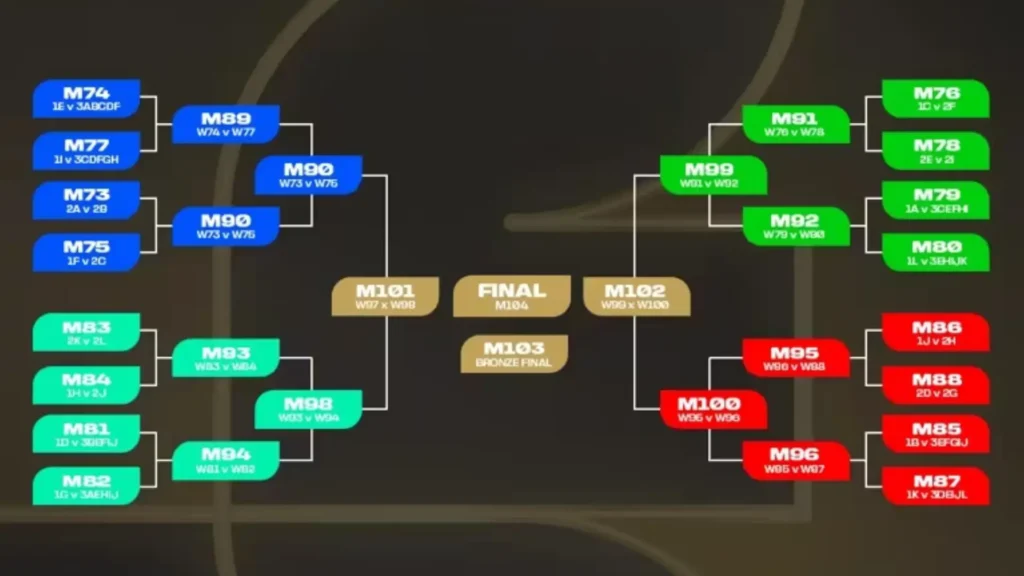
The newly introduced knockout round begins. The top two teams from each group plus the eight best third-placed teams face off.
Round of 16
4 July – 7 July 2026
The traditional single-elimination bracket begins for the remaining 16 international teams.
Quarter-finals
9 July – 11 July 2026
The final eight teams battle for a spot in the final week. From this round onward, all matches take place exclusively in the United States.
Semi-finals
14 July – 15 July 2026
The final four teams compete to determine the two nations playing for the ultimate prize.
Third-Place Playoff
18 July 2026
The losing semi-finalists play for the bronze medal at Hard Rock Stadium in Miami.
World Cup Final
19 July 2026
The championship match takes place at MetLife Stadium in East Rutherford, New Jersey.
How the New 48-Team Knockout Format Works
One of the most complex adjustments for fans is tracking how teams qualify for the expanded knockout bracket. Because the number of groups has grown to 12, the math required to reach the Round of 32 changes:
- Automatic Qualifiers: The top two teams from every individual group (A through L) earn an automatic spot in the Round of 32 (24 teams total).
- Wildcard Spots: The eight best third-placed teams across all 12 groups are ranked via goal difference, goals scored, and fair play points to claim the remaining knockout spots.
- Single Elimination: Once the 32-team field is set, the tournament shifts to a standard single-elimination bracket. If a match is tied after 90 minutes, it goes to 30 minutes of extra time, followed by a penalty shoot-out if necessary.
Finalized World Cup 2026 Groups
The official FIFA draw finalized the placements for the 12 competitive pools. Four of the most highly anticipated groups featuring standout competitive balance include:
| Group A | Group B | Group C | Group D |
| Mexico | Canada | Argentina | USA |
| South Africa | Bosnia & Herzegovina | Japan | Paraguay |
| South Korea | Peru | Egypt | Senegal |
| Czechia | Norway | Scotland | Austria |
Highly Anticipated Group Stage Fixtures
Several standout opening matches are driving massive search volume online, with fans planning travel and broadcast viewing:
- Mexico vs. South Africa (11 June 2026): The tournament’s official opening match will take place at the historic Estadio Azteca in Mexico City. This venue makes history as the first stadium to host matches in three separate World Cup tournaments (1970, 1986, and 2026).
- USA vs. Paraguay (12 June 2026): The United States Men’s National Team (USMNT) opens its highly anticipated home campaign at SoFi Stadium in Los Angeles under immense domestic pressure.
- Argentina vs. Algeria (17 June 2026): The reigning world champions headline a major Central-region draw at Arrowhead Stadium in Kansas City.
- England vs. Croatia (17 June 2026): A classic European heavyweight rematch scheduled at AT&T Stadium in Dallas, Texas.
Host Cities & Stadium Infrastructure
The logistical scale of this cross-continental event requires 16 designated host venues across three countries. The venues are categorized by geographical clusters to manage team travel:
United States Venues
The majority of tournament infrastructure and all fixtures from the quarter-finals onward are located in the US:
- East Rutherford (New York/New Jersey) — MetLife Stadium
- Los Angeles (Inglewood) — SoFi Stadium
- Dallas (Arlington) — AT&T Stadium
- Atlanta — Mercedes-Benz Stadium
- Miami (Hard Rock Stadium) & Seattle (Lumen Field)
- Boston (Gillette Stadium) & Philadelphia (Lincoln Financial Field)
- Houston (NRG Stadium), Kansas City (Arrowhead Stadium), & San Francisco Bay Area (Levi’s Stadium)
Canada & Mexico Venues
- Canada: Toronto (BMO Field) and Vancouver (BC Place).
- Mexico: Mexico City (Estadio Azteca), Guadalajara (Estadio Akron), and Monterrey (Estadio BBVA).
Economic and Physical Impact of the Expanded Format
The financial and operational reality of running a 104-match tournament is unprecedented. According to reports by Reuters, FIFA has increased its financial distribution packages by 15%, letting participating member associations share a record $871 million prize and support ecosystem.
However, football analysts warn that environmental factors will play a defining role on the pitch. Teams will face massive travel distances between matches alongside intense summer heat indexes, particularly in high-humidity regions like Houston, Miami, and New York/New Jersey, where summer temperatures frequently average above 31°C (88°F). To combat this, stadiums like MetLife Stadium have undergone major pitch overhauls, installing advanced hybrid turf ventilation and automated irrigation systems to ensure consistent ball rolling and protect players from muscle injuries.
For complete day-by-day kick-off times and broadcast networks, fans can track live scheduling adjustments on the Sky Sports Football World Cup Hub or view official ticketing guidelines via the FIFA World Cup Official Portal.
Frequently Asked Questions (FAQ)
When does the 2026 FIFA World Cup start and end?
The tournament officially begins on Thursday, 11 June 2026, with the opening match in Mexico City. It concludes with the World Cup Final on Sunday, 19 July 2026.
Where will the 2026 World Cup Final be played?
The final match will be held at MetLife Stadium (referred to during the tournament as the New York New Jersey Stadium) in East Rutherford, New Jersey. The stadium features a capacity of 82,500 spectators.
How many teams qualify under the new format?
A total of 48 national teams qualify for the tournament, an increase of 16 teams over the previous 32-team format used since 1998.
Do third-place group finishers qualify for the knockouts?
Yes. The 12 groups are reduced to 32 teams by taking the top two finishers from each group alongside the eight third-placed teams with the best overall group-stage statistical records.
Which stadium is making history during the opening match?
Estadio Azteca in Mexico City will become the first stadium in international football history to host matches in three distinct men’s FIFA World Cups, having previously served as a primary venue in 1970 and 1986.